Databases
ACID
-
A transaction is a group of operations executed as a single unit of work. An example of a transaction is when money is transferred between bank accounts. Money must be debited from one account and credited to another.
-
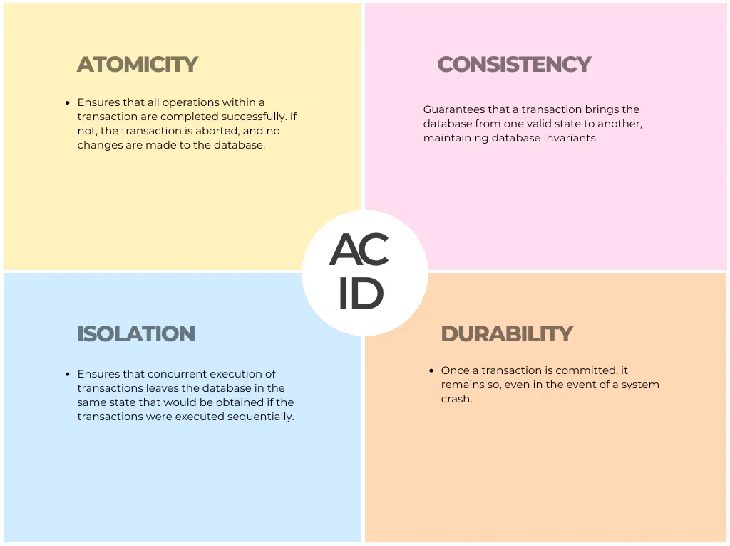
If a database fulfills the following aspects of ACID compliance, it is known to be ACID-compliant. Atomicity compliance ensures that all transactions are completed successfully. If not, the transaction is aborted, and no changes are made to the database.
-
Database transactions, also known as atoms, can be divided into smaller components to ensure their integrity.
-
During a transaction, either all operations occur, or none do. If a debit is successfully deducted from one account, Atomicity guarantees that the corresponding credit is applied to the other account.
-
Atomicity Atomicity is all based around this idea of togetherness. When carrying out any kind of database transaction, it often consists of multiple operations. With atomicity, either every operation succeeds or none of them do. This is important because the operations can have an impact on each other, so one failing can lead to unexpected results.
Think of a financial transaction, for example. You are paying a friend $250 for a holiday you are going on. The whole transaction would consist of the money leaving your account and arriving in the recipient’s account. If there was no atomicity, it is possible that money leaves your account but doesn’t arrive at the other end, resulting in you being debited the money but still owing the recipient.
- Consistency Consistency is about ensuring that changes made as part of a transaction are consistent with any database constraints. If the data at any stage goes against these constraints, the whole transaction will fail.
Unless you have an agreed overdraft, banks, for example, will expect your balance to be positive. So if you tried to withdraw more money than you have available, this would break a constraint and fail, rolling back all operations in that transaction.
- Isolation Isolation is there to make sure that all transactions are run in an isolated environment without interfering with each other.
Sticking with the financial example, imagine you have a bank balance of $200 and you try to withdraw $100 at an ATM. At the same time, a standing order you have set up comes out for $100. With isolation, these transactions can occur concurrently, ensuring that your ending balance is $0, not $100, because the transactions impacted each other.
- Durability Durability is another important element of ACID because it ensures that no matter what happens, once a transaction is complete, the changes in that transaction are written to the database. This makes sure that data changes are persisted, even in the event of a power failure or system crash.
Normalization ? Types of DB ?
Data Definition Language(DDL)
    Create
    drop
    alter
    truncate
Data Manipulation Language(DML)
    insert
    update
    delete
Data Control Language(DCL)
    grant
    revoke
Transaction Control Language(TCL)
    commit
    rollback
    save point
Data Query Language(DQL)
    select

Constraints
    Not Null
    Unique
    primary key
    foreign key
    check
    default

Joins
    join/ inner join
    right join
    left join
    outter join/ FULL OUTER JOIN
    CROSS JOIN
    NATURAL JOIN
Set Operations
    union
    intersect
    except

index
Triggers
Procedures
Database Types
Relational (SQL)
- MySQL, PostgreSQL, Oracle, SQL Server, MariaDB
- Structure: Tables with rows/columns, ACID transactions
- Use: Business apps, financial systems, anything needing transactions
- Pros: Strong consistency, complex queries (JOINs), ACID guarantees
- Cons: Less flexible schema, scaling horizontally is hard
NoSQL
Document Databases
- MongoDB, CouchDB, Firebase
- Structure: JSON-like documents, flexible schema
- Use: Content management, user profiles, catalogs
- Pros: Flexible, fast reads/writes, scales horizontally
- Cons: No strong ACID, eventual consistency
Key-Value Stores
- Redis, Memcached, DynamoDB
- Structure: Simple key → value mapping
- Use: Caching, sessions, leaderboards, real-time
- Pros: Ultra-fast, simple, scales well
- Cons: Limited query capabilities
Column-Family Databases
- HBase, Cassandra, Google BigTable
- Structure: Data stored by column families (optimized for analytics)
- Use: Time-series data, analytics, massive scale (petabytes)
- Pros: Extreme scalability, columnar compression
- Cons: Complex, eventual consistency
Graph Databases
- Neo4j, ArangoDB
- Structure: Nodes and relationships
- Use: Social networks, recommendations, knowledge graphs
- Pros: Fast relationship queries, natural modeling
- Cons: Specialized use cases
Search Engines
- Elasticsearch, Solr
- Structure: Inverted indexes for full-text search
- Use: Search, logging, analytics
- Pros: Fast full-text search, powerful aggregations
- Cons: Not transactional
When to Use Which
| Need | Type | Example |
|---|---|---|
| ACID transactions | SQL | Banking, inventory |
| Flexible schema | Document (MongoDB) | Content management |
| Ultra-fast reads/writes | Key-Value (Redis) | Caching, sessions |
| Time-series/analytics | Column-Family (Cassandra) | Metrics, logs |
| Relationships | Graph (Neo4j) | Social network |
| Full-text search | Search (Elasticsearch) | Search results |
See more: SQL & Relational | NoSQL & Scaling
Db improvements / efficiency - design principles
SQL injection - prevention
JPA Hibernet MyBatis
Concurrency model - optimistic / pessimistic ?
JPA - Jakarta Persistence API Java ORM standard for storing, accessing, and managing Java objects in a relational or NoSQL database. Annotations - https://www.techferry.com/articles/hibernate-jpa-annotations.html#Version
JDBC vs JPA
    https://www.baeldung.com/jpa-vs-jdbc
Cheat Sheets
https://www.interviewbit.com/sql-cheat-sheet https://learnsql.com/blog/sql-basics-cheat-sheet/ https://www.sqltutorial.org/sql-cheat-sheet/
BASE (NoSQL) & CAP
- BASE — Basically Available, Soft state, Eventual consistency (NoSQL trade-off vs ACID).
- CAP theorem — under a network partition you choose Consistency or Availability (Partition tolerance is mandatory in distributed systems).
- RDBMS lean ACID/strong consistency; many NoSQL stores lean AP + eventual consistency.